

 (888) 519-1422
  FREE Spec-Out Request
 Rental Emergency 24/7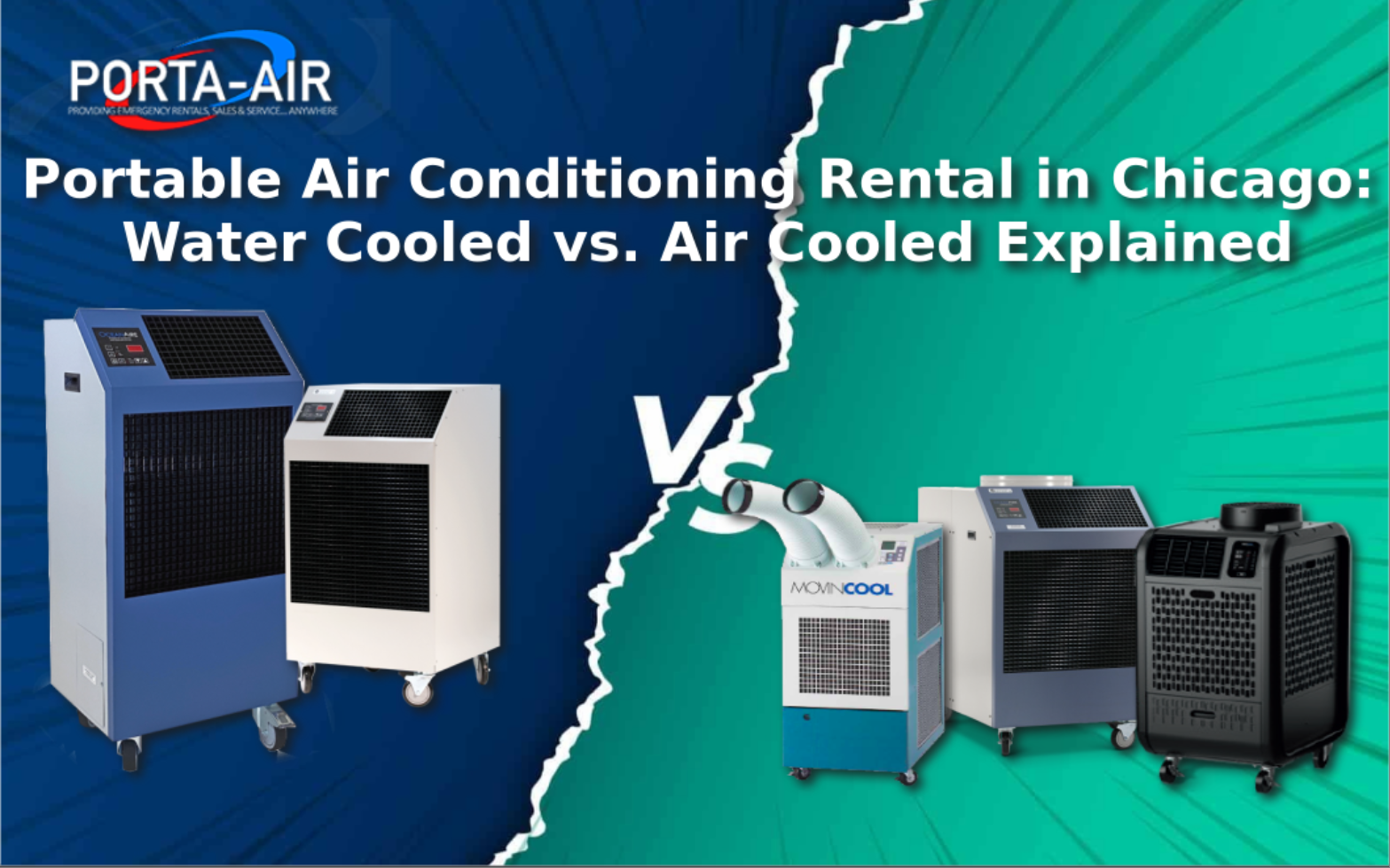
Portable Air Conditioning Rental in Chicago: Water-Cooled vs. Air-Cooled Explained
The intense heat and humidity of Chicago can make a broken AC system an urgent problem. Whether you need temporary cooling for an event, data center, restaurant, or commercial building, emergencies can happen fast. Renting a portable unitary air conditioner—typically referred to as a spot cooler in commercial environments—is a quick and versatile fix. You´ll find two main types of these temporary units: air-cooled and water-cooled portable air conditioners. Selecting the right type is essential for achieving optimal efficiency and performance throughout Chicagoland.
Water-Cooled Portable AC Units: The Efficiency Powerhouse
Water-cooled units are often a better fit for specific commercial or industrial applications where heat loads are extremely high, or hot air venting is not an option.
How They Work
Unlike systems that rely on ambient air to cool condenser coils and dissipate heat, a water-cooled unit utilizes a continuous, regulated flow of water through a shell-in-shell heat exchanger for heat absorption. Cool water enters the unit, absorbs thermal energy, and the now-warmed water is discharged via a secondary hose. Water flow is managed by a regulating valve, ensuring that when the compressor is inactive, water circulation ceases. When less cooling is necessary, the system correspondingly reduces water usage. It is important to note that in a portable water-cooled unit, the water never comes into contact with the air being conditioned—a distinction from evaporative coolers, which increase air humidity. Our water-cooled units are designed exclusively to remove humidity from the air.
Pros Water-Cooled Portable Rentals
- • No Ducting Needed: Water-Cooled portable AC’s do not require a hot air exhaust hose, making them ideal for cooling fully enclosed, sealed environments like data closets, restaurants, bars, kitchens or specific floors in commercial high-rise buildings where a window vent is impossible.
- • Greater Efficiency in Extreme Heat: When temperatures rise above 100°F or 115°F, water-cooled portables typically outperform air-cooled units, delivering cooler air without compressor overload or high-pressure faults.
- • Quieter Operation: Without the need for an additional larger fan to discharge hot air out of the space, like an air-cooled unit, water-cooled units can sometimes run more quietly because of one less motor/fan.
- • Compact Yet Efficient: These units feature a reduced footprint due to their smaller size, as the condenser occupies less space and does not require a separate blower or motor assembly.
- • Condensate Pump: All water-cooled units are equipped with a condensate pump and do not require emptying of the condensate bucket.
Cons to Consider
- • Plumbing Requirement: These units require a continuous connection to a water source (like a faucet or hose bib, chiller or cooling tower) and a drain (like a sink, shower, or floor drain). The installation requires more labor to install and can be limited to portability if extra-hose length is not provided.
- • Water Usage: They consume water, which can be a cost consideration, and they are less suitable for areas with strict water-use restrictions.
- • Water Source: Occasionally, employees may shut off the water or switch on the hot water, which can disrupt the proper functioning of the unit and become an inconvenience.
Air-Cooled Portable AC Units: The Flexible Solution
Air-cooled portable ACs are the most common and widely rented units in Chicago due to their simplicity and high mobility.
How They Work
Air-cooled units operate by employing internal fans that circulate air across refrigerant-filled coils, thereby absorbing and dissipating heat from the room. The cooled air is subsequently returned to the space, while the exhaust—comprising heated air—is expelled through a dedicated duct that must be directed outside via a window, doorway, ceiling tile, or vent.
Pros for Air-Cooled Portable Rentals
- • Plug-and-Play Setup: They require minimal installation—just a standard electrical outlet or wired for larger units, and a way to vent the hot air. This makes them ideal for temporary offices, small server rooms, and quick emergency cooling.
- • High Portability: As these smaller units do not require a condensate drain line or water connections, they offer exceptional mobility. They can be easily transported between locations, and installation of the hot air vent hose is straightforward.
- • No Water Hookup: You don´t have to worry about securing a constant water supply or drain, simplifying placement when a condensate bucket is used.
Cons to Consider
- • Venting Requirement: The need to vent hot air out of the space being cooled means they are less effective in sealed, high-heat environments, where ducting the hot air out is difficult (like certain retail spaces or open-ceiling restaurants). If not properly installed, portable air-cooled units can have a negative cooling effect.
- • Max BTU Output: Although portable units are available in high-capacity sizes, the maximum cooling capacity (such as 149,000 BTU/hr.) is most commonly associated with air-cooled models. This feature may offer limited advantages for applications involving larger spaces.
- • Condensate Bucket/Pump: For smaller units, cooling stops when the condensate bucket becomes full and must be emptied before operation can resume. If continuous 24/7 use is needed, a condensate pump is an option for smaller temporary portable air-cooled units, which will incur a modest rental fe
Which Unit is Right for Your Chicago Rental Needs?
| Feature | Air-Cooled Rental System | Water-Cooled Rental System |
|---|---|---|
| Mobility | High (Portable, easy to move) | Moderate to Low (Requires water source/drain) |
| Setup Complexity | Plug-and-Play (Requires exhaust hose/vent) | Requires Plumbing Hookup (No venting needed) |
| Ideal Environment | Offices, server rooms, events, construction sites, where venting is easy. | Sealed indoor spaces, high-heat industrial applications, where water access is easy. |
| Condensate | Collects water in a tank or uses a pump for drainage. | Standard condensate pump with all units and drain hose part of three-piece hose kit – water-in, water-out and drain. |
For a wide range of cooling requirements—whether temporary, permanent, backup, or emergency—within the Chicago area, an air-cooled unit is generally recommended when venting is feasible. In situations where venting hot air outside the cooled space is not possible and water or drainage is accessible, a water-cooled unit typically offers the most suitable solution.
If you are tasked with cooling a pizza parlor equipped with venting, but face high ambient temperatures in the surrounding environment, a water-cooled spot cooler may offer enhanced performance, provided that adequate water flow and drainage are ensured.
Companies such as Porta Air supply temporary rental units that are either air-cooled or water-cooled. They also give a free "spec-out" to help you find the most suitable and affordable portable AC rental option for your needs.